Introduction
We have all heard the name Golden Temple since childhood, but its real identity is understood only when you actually reach there. After passing through the crowded lanes of Amritsar, the moment you step at the main entrance of the temple, your walking pace automatically slows down. You feel a strange kind of peace — the kind of peace that can never be captured in a photograph.
There are many temples in India, but the Golden Temple is a completely different kind of place. It is not just a building covered with gold; it is a living form of equality, service (seva) and humility. When people come here for the first time, they are often surprised by the shine of gold, but to be honest, the real beauty here is not in the shine, it is in the intention for which it was built. No one is asked which religion they belong to — the doors are open for everyone, without any discrimination. Maybe that is why this place is considered so respected and spiritually powerful all over the world.
Now let’s talk about the name — because that is the first misunderstanding many people have.
We casually call it “Golden Temple”, but the real name is Harmandir Sahib.
“Harmandir” means the court of Hari (God) — a place where God is present not just for one community but for every human being. The golden covering came much later; even before that, this place was already “beautiful” because of its soul.
And why is all of this in Amritsar?
Because this city has always been special for its liveliness, history and openness. There is a different kind of warmth in the lanes of Amritsar — and the brightest symbol of that warmth is the Golden Temple.
Where Is the Golden Temple and Why Is Amritsar So Special?
This sacred site is located in Amritsar.
The name Amritsar comes from the word “amrit” — meaning the pool of immortality.
It is believed that the city was named after the sacred pool which is known today as Amrit Sarovar.
This sarovar is not just a big water tank; it is the center of Sikh faith.
People look at their own reflection in this water and feel the burden of their soul getting lighter. Many devotees bathe here during the early “Amrit Vela” and never forget that experience for the rest of their lives.
History: How Was the Golden Temple Built and Who Covered It in Gold?
The history of the Golden Temple is not written just in dates, but in ideas.
• Foundation — 1500s
- Guru Amar Das identified this place as a spiritual center.
- Guru Ram Das got the sarovar constructed and
- Guru Arjan Dev started the construction of the temple in 1581.
• A Unique Decision — The Temple Was Built Below Ground Level
Most religious places in the world are built on elevated land, but Harmandir Sahib was built below the ground level.
This was to give a message:
“The one who bows down, is the one who truly rises.”
• A Temple Open from All Four Directions
This is one of the few religious places in the world that has doors on all four sides.
It is a symbol of equality —
“Whichever direction you come from, you are welcome.”
• When Was the Golden Layer Added?
In the 1800s, Maharaja Ranjit Singh got the upper part of the temple covered with gold.
Since then, it became famous across the world by the name “Golden Temple”.
But even today, the real gold here is its service, devotion and humility.
Architecture of the Golden Temple
The Golden Temple is not just a beautiful building — it is a blend of design and spirituality that inspires architects all over the world.
The Importance of the Sarovar (Amrit Sarovar)
The water here is calm, but there is such purity in its depth that many visitors sit at the edge of the sarovar and get lost in meditation for hours.
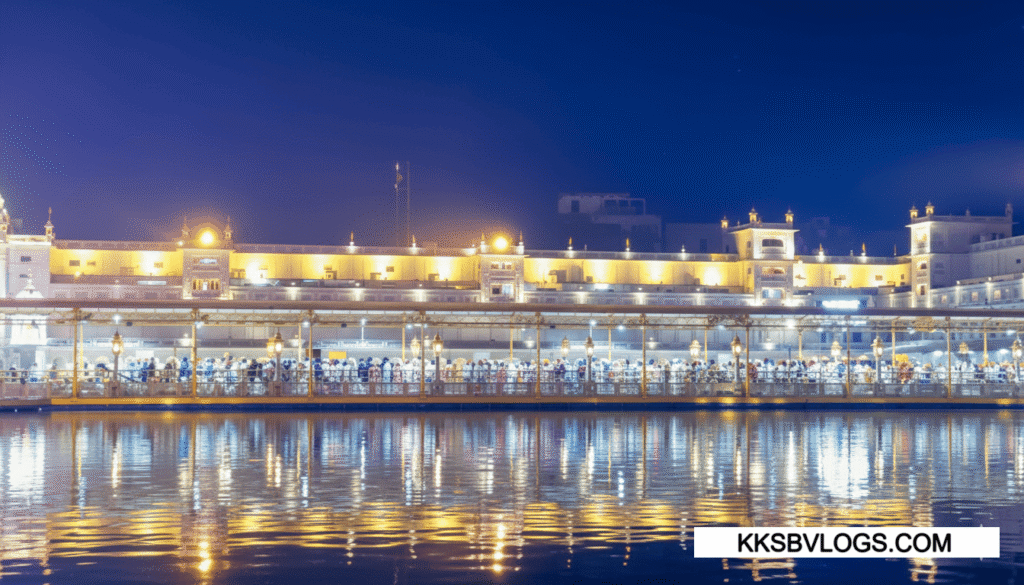
The Bridge to the Temple (Guru’s Bridge)
This bridge feels like the journey of life — walk slowly, empty your mind, and in the end, reach the light.
The Difference Between Day and Night
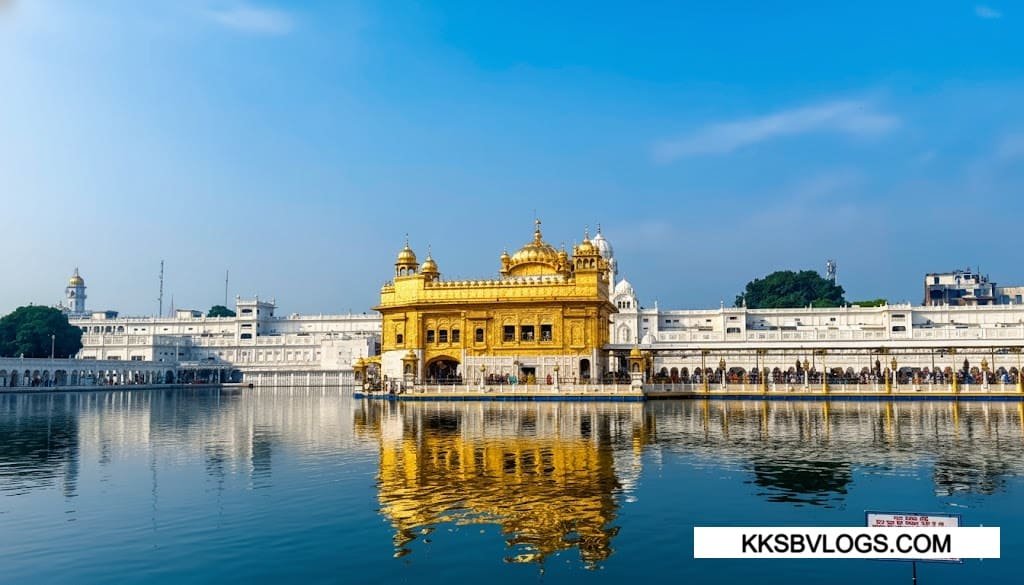
- During the day, the temple shines in the water like a flame of gold.
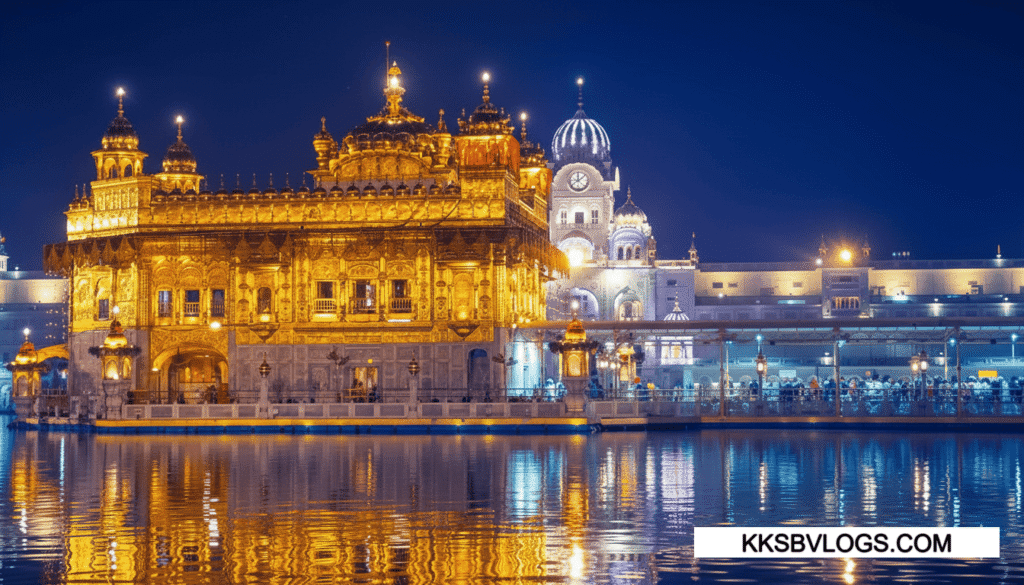
- At night, it becomes a white temple covered in soft moonlight, giving a strange sense of coolness to the heart.
If you are a photographer, this place should be seen twice — once in the morning and once at night.
Why Do People Become Emotional at the Golden Temple?
The environment of the Golden Temple does not make everyone feel the same way;
everyone experiences it in their own way.
Some feel peace,
some feel relief,
some feel gratitude,
some feel energy,
and some feel as if someone has placed a hand on their shoulder and said:
“Everything is going to be fine.”
These emotions do not come just because this is a religious place, but because of the combined effect of the atmosphere, langar, voluntary service (seva) and kirtan.
The Most Unique Aspect of the Golden Temple – Langar (Community Kitchen)
Here you find the world’s largest free community kitchen, where around 1 lakh people eat every day.
Speciality of this langar:
- Anyone can come
- Everyone sits together in the same place
- No discrimination
- Food is prepared 100% by volunteers
- Dal, roti, sabzi, kheer — everything is very simple, yet deeply touching
Many travellers consider the Langar to be the most healing experience of the Golden Temple.
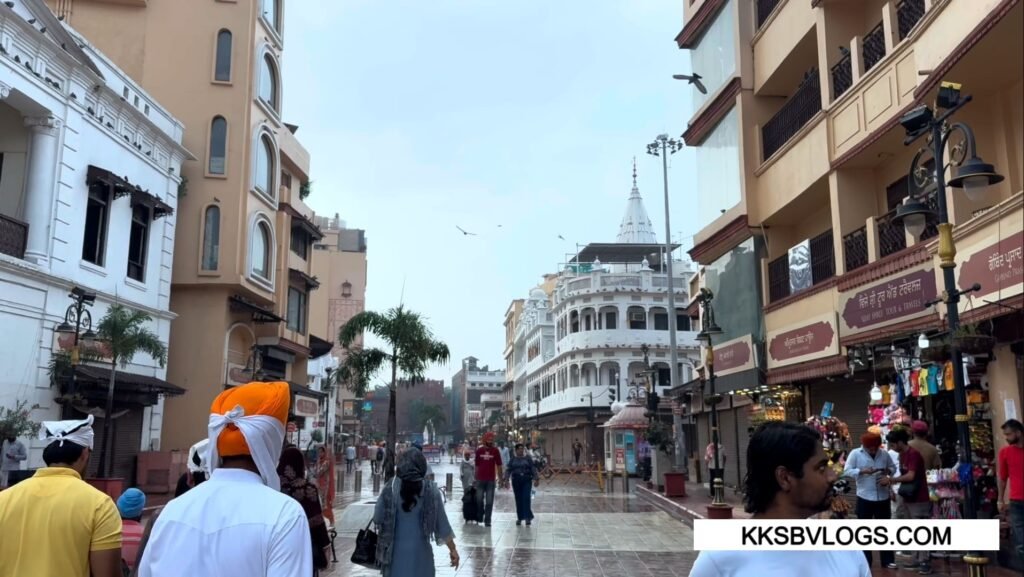
Golden Temple Experience: Darshan, Timings, Rituals, Night View, Rules, Crowd Navigation & Nearby Places
The Golden Temple is not just a building — it is a living experience.
Every hour, every moment, something is happening here.
Sometimes the sound of kirtan spreads in the air, sometimes the sound of utensils in the langar, sometimes the play of light on the water…
The spirituality here does not come from “promotion”, it comes from the environment itself.
In this PART, we will understand the journey of the Golden Temple step-by-step, so that any first-time visitor can have a complete experience without confusion.
1) Best Time to Visit the Golden Temple – Morning, Evening or Night?
The Golden Temple is that rare place which shows a completely different form in all three parts of the day.
If you want to provide a perfect travel experience, it is important to explain this clearly.
1) Morning – Amrit Vela (4 to 6 AM) — The Most Divine Time
This is the time when the entire complex is peaceful.
The day begins with the melodic recitation from Guru Granth Sahib.
The light chill in the air combined with this peace gives such a feeling that it seems like this world belongs to another planet.
- → Best time for photographers
- → Crowd is minimal
- → Reflection in the water is crystal clear
2) Afternoon – Best Time for the Langar Experience
In the afternoon, the sun is overhead and the golden covering on the temple shines intensely.
This is the time for:
- ✔ Langar
- ✔ Viewing the Sarovar
- ✔ Sitting quietly in the complex
- ✔ Understanding the Gurudwara lifestyle
3) Evening – Golden Hour + Evening Kirtan
This is the most photogenic moment of the Golden Temple.
The rays of the sun fall on the golden surface and the entire temple glows.
4) Night – The Most Magical Form of the Golden Temple
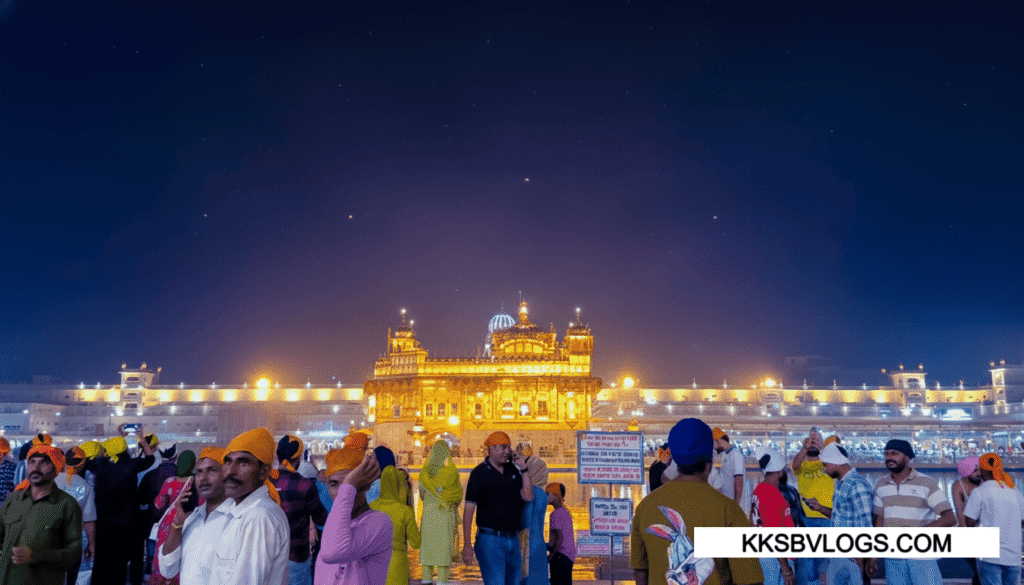
At night, the entire complex looks like an enchanted world bathed in white light.
When silence prevails and the reflection of lights moves gently on the water, the Golden Temple takes on a completely different form.
2) Golden Temple Timings — Which Ritual Happens When?
The Golden Temple is open 24 hours, but the rituals inside happen at specific timings.
1) Prakash Ceremony (Morning 4–5 AM)
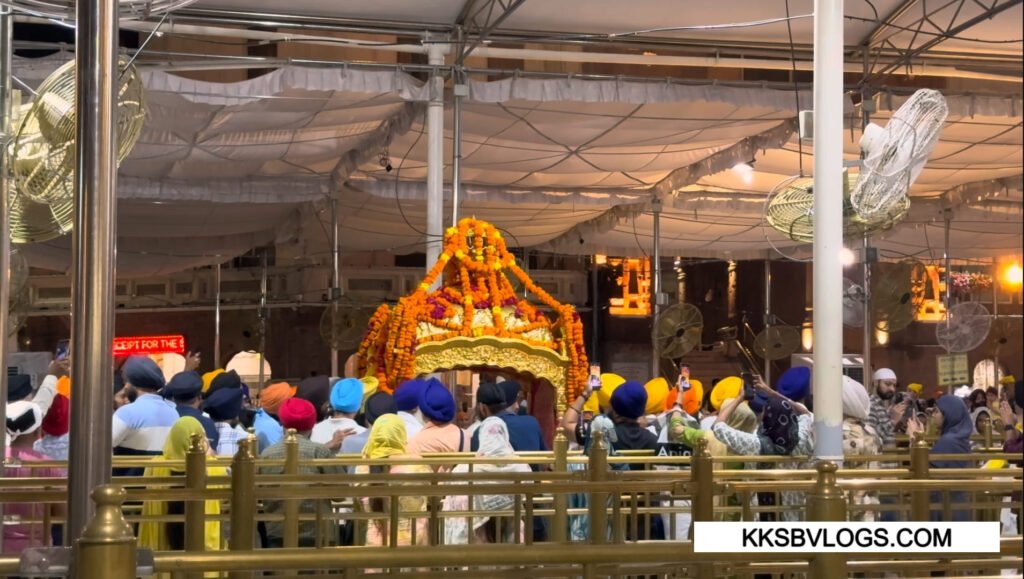
Guru Granth Sahib is brought in a palanquin and placed in the main sanctum.
This time is very peaceful and deeply spiritual.
2) Continuous Kirtan (From Morning to Night)
Live kirtan is performed daily — this is the heartbeat of the Golden Temple.
3) Sukhasan Ceremony (Night 9:30–10:30 PM)
At night, Guru Granth Sahib is respectfully taken back towards the Akal Takht.
This palanquin procession becomes an unforgettable experience for visitors due to its calmness and discipline.
3) How to Do Darshan at the Golden Temple? Step-by-Step Practical Guide
Many people come here for the first time and get confused — where to go? where to keep shoes? how will the queue be?
This guide removes that confusion.
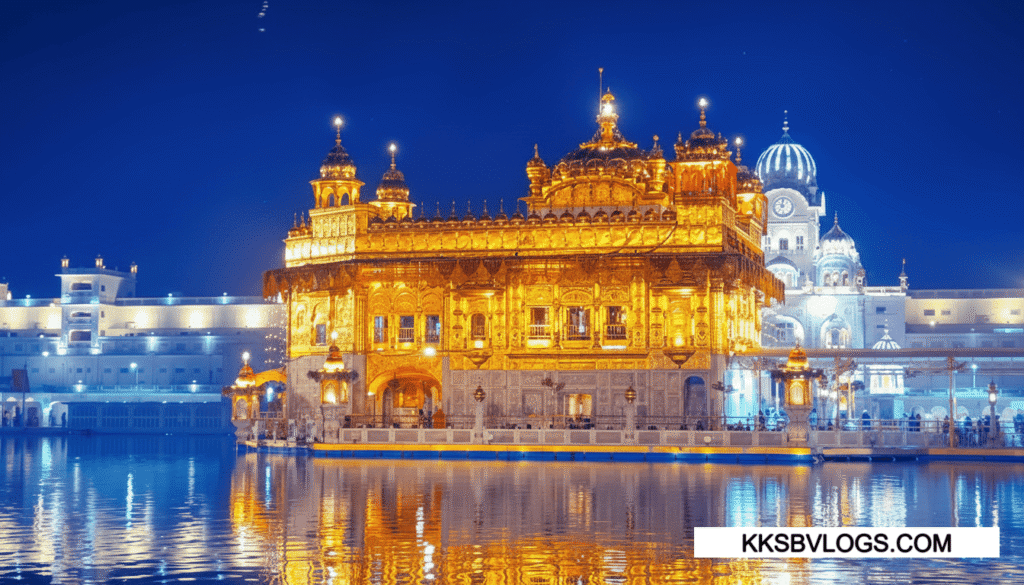
✔ Step 1 — Follow the Traditional Dress Code
Both men and women must cover their heads.
Free scarves are available at the entrance.
✔ Step 2 — Deposit Footwear at the Shoe Counter
Shoes and slippers are kept at free shoe counters (a highly organized system).
✔ Step 3 — Entry to the Sarovar and First Darshan
As soon as you enter from the big gate, you see the calm water in front and Harmandir Sahib in the middle.
✔ Step 4 — Join the Queue (Crowd Is Heavier in the Evening)
Peak hours:
- Morning: 8–11 AM
- Evening: 6–9 PM
If you want to avoid the crowd, go in the afternoon or late night.
✔ Step 5 — Enter the Sanctum and Have Darshan
Inside, you are allowed to stand for a few seconds to around 2 minutes, depending on the crowd.
4) Photography Rules at the Golden Temple — New Travellers Often Break These
Photography is broadly allowed, but some rules must be followed:
- Photography is not allowed inside the main sanctum (inner chamber)
- While standing on the boundary of the sarovar, your mobile can fall into the water — be careful
- Do not photograph volunteers without permission
- Avoid using big cameras inside the Langar hall
Looking at the dignity and sanctity inside the Golden Temple, people naturally become respectful.
5) Dress Code — Simple but Important Rules
- Head must be covered (men and women both)
- Wear modest clothing
- Avoid shorts
- Sleeveless is okay but a respectful look is preferred
Tourists often think this is “strict”, but in reality, it is a very simple and respectful protocol.
6) How to Avoid the Crowd at the Golden Temple?
These tips must be in your blog — because visitors get most frustrated here.
✔ Best Time to Visit with Less Crowd:
- 4–6 AM (Amrit Vela)
- 2–4 PM (Afternoon)
- 10:30 PM–12 AM (Late night)
✔ Avoid:
- Weekends
- Festivals
- Tourist season evenings (October–January)
✔ Special Tip:
Entry through Heritage Street is smoother and more comfortable.
7) Best Places to Visit Around the Golden Temple
Coming here and returning after seeing only the temple would be foolish.
You must include these places in your blog because Google shows them in related searches.
1) Jallianwala Bagh (Walking Distance)
Jallianwala Bagh is the historical memorial of the tragic incident of 1919.
The silence here feels very deep.
2) Akal Takht (Inside the Golden Temple Complex)
Akal Takht is the spiritual and administrative authority of Sikhism.
The energy of this place is considered very powerful.
3) Heritage Street Amritsar
A well-lit street stretching from the Golden Temple entrance to Town Hall.
Here you will find street food, local shops, cafés and Instagram-worthy spots.
4) Durgiana Temple (Around 3 km Away)
Durgiana Temple architecturally looks similar to the Golden Temple but is a Hindu temple.
5) Wagah Border (30–32 km)
Wagah Border hosts the India–Pakistan Retreat Ceremony — a powerful patriotic experience worth seeing at least once.
8) What to Eat Near the Golden Temple? — Because Food Is the Soul of Amritsar
In Amritsar, food is not just food — it is culture.
✔ Must-Try Food Near the Golden Temple:
- Amritsari Kulcha
- Langar ki Dal
- Lassi
- Desi Ghee Jalebi
- Kadha Prasad (the sacred offering of the Golden Temple)
✔ Famous Spots:
- Kesar Da Dhaba
- Giani Tea Stall
- Bharawan Da Dhaba
Golden Temple Trip Planning: Perfect Itinerary, Budget, Safety, Etiquette, Visitor Mistakes
The spiritual peace of the Golden Temple is best felt when the trip is planned properly.
Understanding the crowd, timings and arrangements can completely change the experience.
In this PART, we will understand how to plan a trip to Golden Temple Amritsar so that any visitor — family, couple, solo traveller or senior citizen — can comfortably feel the divine energy here.
1) Perfect Itineraries for the Golden Temple (1-Day, 2-Day & 3-Day Plans)
1-Day Itinerary (Only for the Temple + Nearby Spots)
If you have only one day, this is the best structure:
Morning (4:30–7 AM):
- Reach the Golden Temple during Amrit Vela
- Witness the Prakash Ceremony
- Sit by the sarovar and experience the sunrise
7–9 AM:
- Do darshan
- Receive Kadha Prasad
9–11 AM:
- Go to the Langar Hall
- Experience Langar
- Take a full round of the complex
11–1 PM:
- Visit Jallianwala Bagh
Evening:
- Walk along Heritage Street
- Enjoy the evening lighting and view of the Golden Temple
Even this short itinerary delivers the complete essence of the Golden Temple.
2-Day Itinerary (Most Recommended for Best Experience)
DAY 1:
Morning:
- Golden Temple sunrise
- Darshan + Sarovar experience
Noon:
- Langar
- Akal Takht darshan
Evening:
- Shopping at Heritage Street
- Local food tasting (Kesar Da Dhaba, Bharawan Da Dhaba, etc.)
Night:
- Witness the Sukhasan Ceremony
- Enjoy the divine night illumination of the Golden Temple
DAY 2:
- Visit Durgiana Temple
- Visit Partition Museum
- Attend Wagah Border Ceremony
This itinerary shows the cultural, spiritual and historical balance of Amritsar.
3-Day Itinerary (For Deep Immersion Travellers)
DAY 1:
Golden Temple + Langar + Night View
DAY 2:
Jallianwala Bagh, Partition Museum, Heritage Street,
Local markets + Food trail
DAY 3:
Wagah Border + Rural Amritsar village experience
This itinerary shows travellers the full identity of Amritsar — history, spirituality, culture, food and patriotism.
2) Golden Temple & Amritsar Trip Budget (Honest Breakdown)
The budget below is for 1–2 days:
⭐ 1) Accommodation:
- Budget hotels: ₹800–1200
- Mid-range: ₹1500–2500
- Near Golden Temple: ₹2000–3500
⭐ 2) Food Cost:
- Langar – free
- Local meals: ₹200–₹500 per meal
- Famous restaurants: ₹300–₹800
⭐ 3) Transportation:
- Autos: ₹80–₹200
- Cab (Wagah Border): ₹1000–1500
⭐ 4) Sightseeing:
Mostly free — Golden Temple, Jallianwala Bagh, Heritage Street
Partition Museum: ₹10–₹250
⭐ Average Total Budget (1–2 Days):
- ✔ Budget Traveller: ₹800–1500/day
- ✔ Mid-range Traveller: ₹1500–3000/day
- ✔ With Wagah Border Taxi: + ₹1000
Amritsar is one of those rare cities where you can get a full experience even with a low budget.
3) Is the Golden Temple Safe? (Yes, But Follow These Small Rules)
The Golden Temple complex is one of the safest and most well-organized religious places in India.
You will find volunteers and guards in every corner.
✔ Safe for:
- Families
- Solo travellers
- Couples
- Senior citizens
✔ Follow Some Basic Rules:
- Be careful near the edge of the sarovar
- Take care of your mobile in the crowd
- Maintain patience in the queue
- Behave respectfully
People here themselves come forward to help each other — this is the identity of Amritsar.
4) Cultural Etiquette: What to Do and What Not to Do
✔ DOs (What You Should Do):
- Cover your head
- Remove shoes outside
- Clean your hands and feet
- Sit in an orderly way in the Langar hall
- Receive Prasad with respect
❌ DON’Ts (What You Should Not Do):
- Do not take photos inside the sanctum
- Do not throw litter in the sarovar
- Do not argue with volunteers
- Do not push in the queue
- Do not talk loudly
The peace here is its real ornament — do not disturb it.
For more travel content and related posts, visit my Instagram @official_kksb and my YouTube channel KKSB Vlogs.
What is the best time to visit the Golden Temple for darshan and photography?
The best time is early morning Amrit Vela (4–6 AM) when the crowd is less and the reflection of the sarovar looks the most beautiful. For photographers, the golden hour in the evening (5–7 PM) is also perfect.
Is there any entry fee, dress code or mandatory rules at the Golden Temple?
Entry is FREE. Covering the head is compulsory, shoes must be kept outside and photography is not allowed inside the sanctum. Wearing respectful clothing is necessary.
How long does it take to complete a full Golden Temple visit including Langar?
During non-peak hours, the full visit takes around 1.5–2 hours. During peak hours or weekends, this can increase up to 3 hours.
What are the Golden Temple darshan timings for Prakash and Sukhasan ceremonies?
The Prakash Ceremony takes place in the morning around 4:00–5:00 AM, while the Sukhasan Ceremony happens between 9:30–10:30 PM at night. Both rituals are open to visitors.
Is the Golden Temple safe for solo female travellers or late-night visits?
Yes, the complex is safe 24×7, and there is continuous volunteer presence. Solo travellers, families and women — for all of them, night time is also considered safe.
Can anyone eat langar at the Golden Temple and how does the system work?
Yes, any person can eat langar — there is no restriction of religion or caste. Langar serves simple, fresh food to lakhs of visitors every day completely FREE, and it is prepared by volunteers.
Which places can be covered near the Golden Temple on the same day?
Within walking distance, you can see Jallianwala Bagh, Heritage Street, Sikh Museum and Akal Takht. If you have time, you can also attend the Wagah Border ceremony in the evening.
Which gate or entry route is best for visiting the Golden Temple with less crowd?
The Heritage Street entrance (Town Hall side) is considered the smoothest and least crowded entry route. This route is also the most photogenic.